
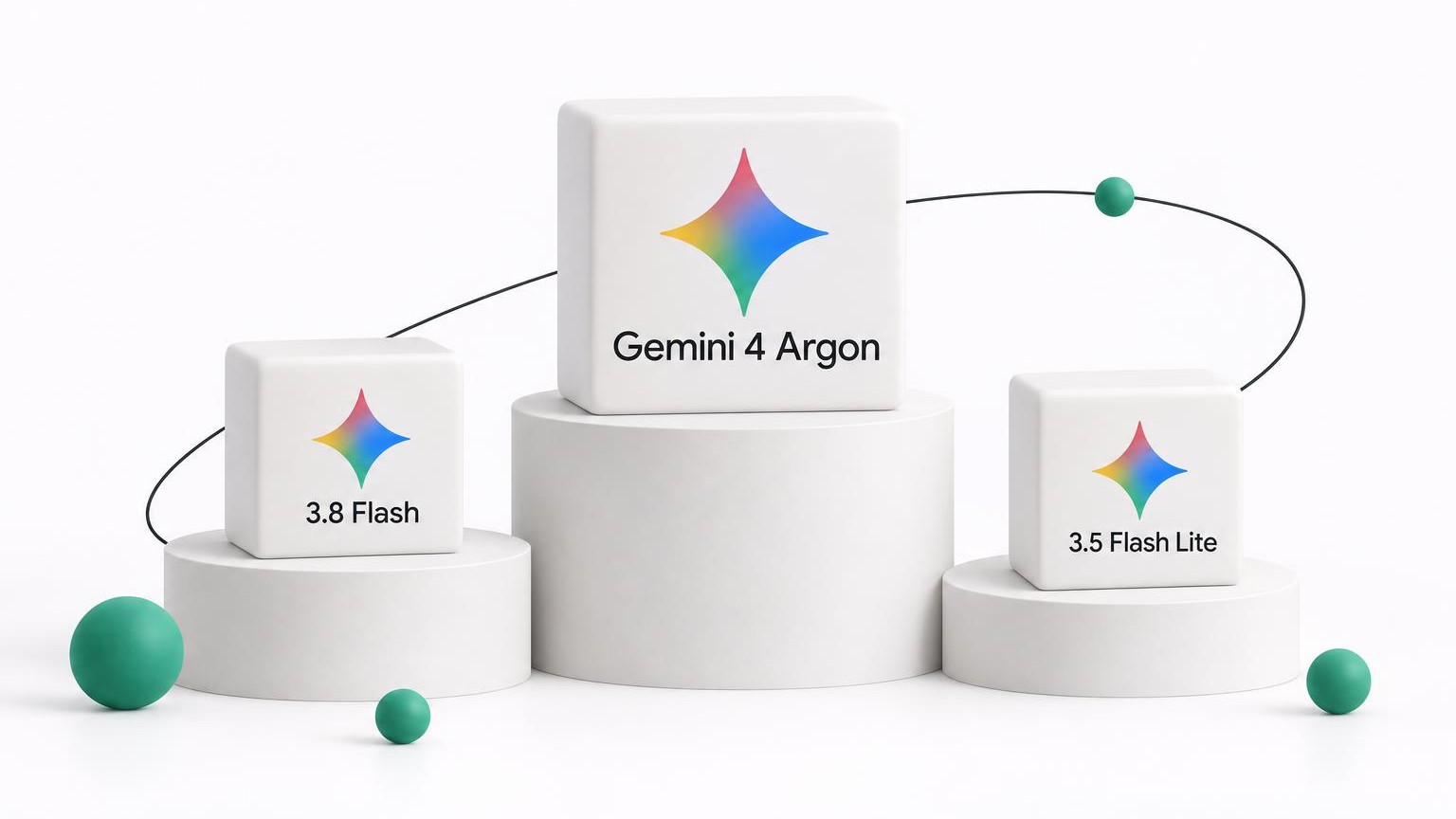
On October 13, 2026, Google introduced Gemini 4 Argon, the first model in the new Gemini 4 family. On ChatX, Argon is now the most capable Gemini model. Gemini 3.8 Flash stays on as the all-rounder and Gemini 3.5 Flash Lite as the budget option. Here’s where Argon leads, where it doesn’t, and which of the three models is worth using for which tasks.
What sets Gemini 4 Argon apart
In its announcement, Google describes Argon as a model for the toughest tasks (“built to solve your hardest problems”). That means long analyses, demanding code, math, and science questions.
Three features matter in everyday use:
- Very long context: Input and output combined can run to as many as 1 million tokens. That’s enough for very long documents or extensive chat histories.
- Up-to-date knowledge: According to the model card, its knowledge extends to March 2026. For anything more recent, you can turn on web search on ChatX.
- Images as input: You can upload photos, screenshots, or charts and ask questions about them.
Argon thinks before every reply. On ChatX, you control how thoroughly with the levels Low, Medium, and High. This model has no “Off” level. ChatX doesn’t display the thinking steps themselves, but they do count toward billing.
At the end of October, Google already announced an even more powerful model, Gemini 4 Carbon. So far it is only open to selected security partners, so it isn’t on the table for ChatX.
Benchmarks: often ahead, but not everywhere
The figures come from Google’s model card from October 2026. For comparison, they’re shown next to three models you also know from ChatX.
| Test | Gemini 4 Argon | GPT-6 Astra | Claude Fable 5.1 | Claude Opus 5.5 |
|---|---|---|---|---|
| Knowledge work (Vals Index) | 68.9% | 63.1% | 65.8% | 67.0% |
| Coding (DeepSWE v1.1) | 77.9% | 74.1% | 67.4% | 74.2% |
| Very long texts (GraphWalks, 256k to 1M) | 84.2% | 71.8% | 65.0% | 66.8% |
| Understanding long videos (LVBench) | 91.7% | 87.5% | 79.7% | 83.7% |
| Coding (FrontierSWE v2) | 55.0% | 65.5% | 56.3% | 62.3% |
| Working in the terminal (Terminal-bench 4.0) | 57.4% | 58.2% | 57.9% | 66.4% |
The lead is clearest with very long texts: for inputs between 256,000 and 1 million tokens, Argon is more than twelve points ahead of the next model. That suggests Argon copes well with a thick manual or many files at once.
For coding, the picture is mixed. Argon leads in DeepSWE, while GPT-6 Astra and Claude Opus 5.5 are ahead in FrontierSWE v2 and Terminal-bench 4.0. There are two more things you should know: Google published these numbers itself. And Claude Fable 5.2, which has been available since November 9, isn’t in the table yet.
Argon, 3.8 Flash, or Flash Lite?
There are now three Gemini models to choose from on ChatX. They differ mainly in thoroughness and price.
| Model | Designed for | Access |
|---|---|---|
| Gemini 4 Argon | hard tasks, long documents, difficult code | free account |
| Gemini 3.8 Flash | everyday use: writing, analysis, translation, code | free account |
| Gemini 3.5 Flash Lite | quick, simple questions and short texts | no sign-up needed |
Gemini 3.8 Flash has been on the market since September 2, 2026. Google calls it “our most intelligent workhorse model”. For most questions, it’s the sensible choice. You can try Flash Lite right away without signing up.
Our test: three tasks, three models
We gave the three Gemini models the same tasks: a math problem with two trains, a short email to a landlord, and a PHP function for validating an IBAN. Each model ran once at its default setting, which means Argon and 3.8 Flash ran at the Low thinking level.
| Task | Gemini 4 Argon | Gemini 3.8 Flash | Gemini 3.5 Flash Lite |
|---|---|---|---|
| Math problem | 13.4 seconds, about 1,500 tokens | 9.7 seconds, about 1,000 tokens | 2.1 seconds, about 370 tokens |
| Email to a landlord | 7.9 seconds, about 450 tokens | 3.4 seconds, about 170 tokens | 1.2 seconds, about 100 tokens |
| IBAN validation in PHP | 9.7 seconds, about 1,300 tokens | 4.7 seconds, about 440 tokens | 1.4 seconds, about 220 tokens |
On the math problem, Argon and 3.8 Flash arrived at the correct result: the trains meet shortly after 10:10 a.m. Flash Lite miscalculated and said 10:29 a.m. Argon also double-checked its result by verifying the answer. The email was usable from all three models. For tasks like that, Flash Lite is enough, and it was done in just over a second.
The test is a spot check with one run each. But it does show the pattern: Argon takes longer and costs more, and in return it delivered the most thorough answer to the tricky math problem.
What a reply costs on ChatX
ChatX bills based on the actual costs charged by the provider. In our test, a reply from Argon cost between about 450 and 1,500 tokens, compared with about 170 to 1,000 tokens for 3.8 Flash and about 100 to 370 tokens for Flash Lite. Depending on the task, that makes Argon roughly one and a half to three times as expensive as 3.8 Flash. In a longer chat, the conversation so far is added as input. At the Medium and High levels, the model thinks longer, and usage goes up noticeably.
Important for planning: Google is offering Argon at an introductory price until November 30, 2026. Starting December 1, Google will double the price. From then on, twice as much credit will be deducted on ChatX as well, which in our test would mean about 900 to 3,000 tokens per reply. For Gemini 3.8 Flash, the introductory price ends at the turn of the year.
Tips for getting started
- Flash first, then Argon: Ask Gemini 3.8 Flash your question first. If the answer isn’t good enough, switch to Argon in the same chat.
- Low for writing: Emails, summaries, and translations don’t need long thinking. That saves tokens.
- High for hard cases: Tricky calculations, debugging code, or comparing several long documents are what Argon was built for.
- Web search for current topics: Argon’s knowledge ends in March 2026. For news, prices, or new products, turn on web search.
- Ask targeted questions about long documents: According to the benchmarks, this is where Argon is strongest. Keep in mind, though, that the longer the input, the more tokens each message costs.