
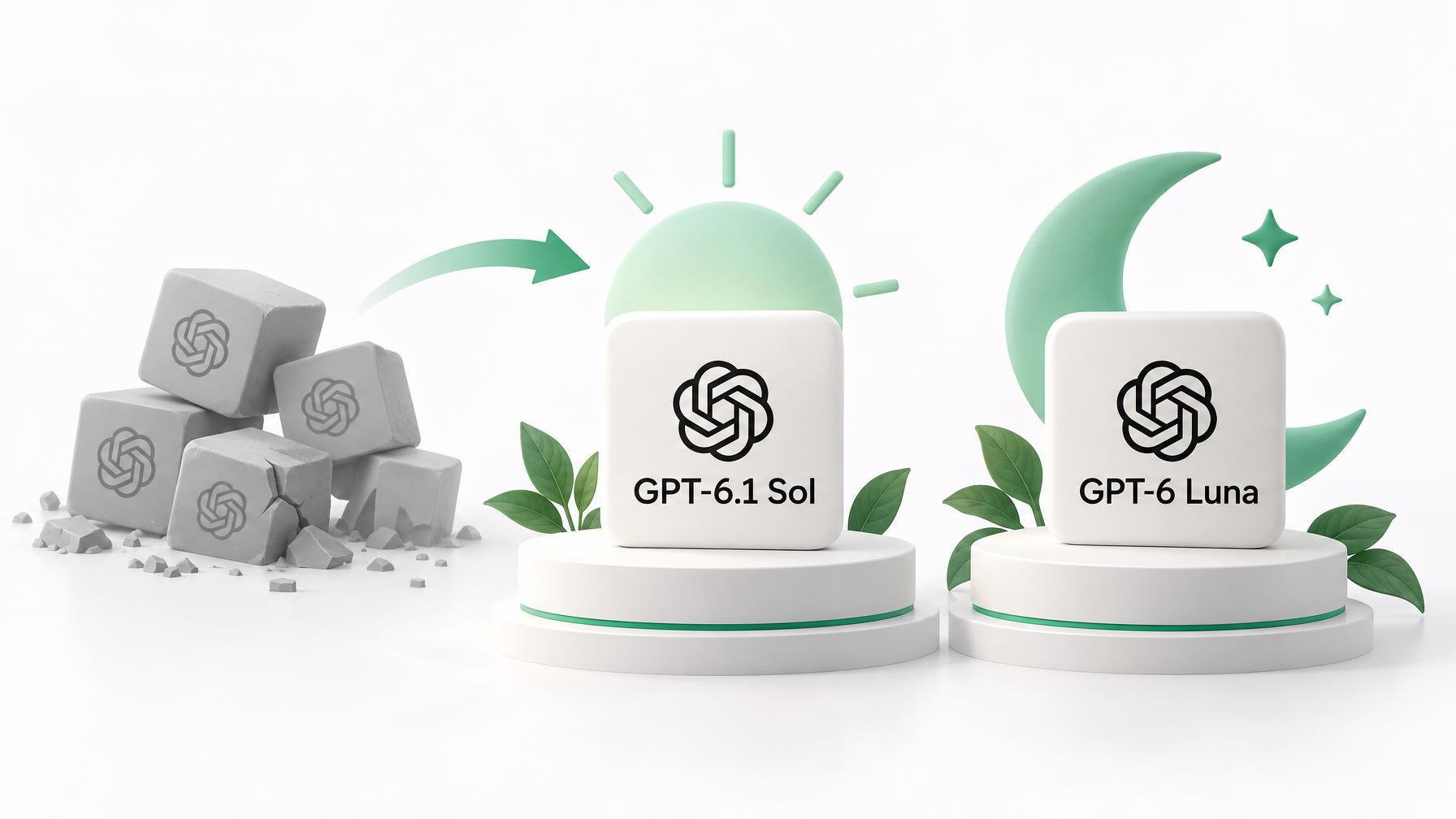
OpenAI has added two new models. GPT-6 Luna is the low-cost model for everyday work, GPT-6.1 Sol comes close to GPT-6 Astra and costs a fifth of it. Both are available on ChatX now and replace the previous 5.6 series. The biggest change is for users of GPT-5 nano, because that model is no longer offered on ChatX.
The new GPT selection on ChatX
Under GPT there are now exactly three models to choose from. GPT-5.6 Terra and GPT-5.6 Luna have disappeared from the list, existing chats with these models are of course kept. The table shows what each model is meant for and how the token costs compare.
| Model | Use | Depth of thought | Token cost |
|---|---|---|---|
| GPT-6 Luna | Everyday questions, summaries, short texts, understanding images | Off, Low, Medium, High | about a twentieth of Sol |
| GPT-6.1 Sol | Coding, documents, multi-step tasks, web search | Low, Medium, High | about a fifth of Astra |
| GPT-6 Astra | The hardest tasks without compromise | Low, Medium, High | reference |
What GPT-6.1 Sol can do
GPT-6.1 Sol is the revised version of GPT-6 Sol, which had been introduced a week earlier. ChatX moved straight to the new version. OpenAI describes it as intelligence close to Astra level for a fifth of the price. The published tests back that up in most areas.
- Coding: On DeepSWE v1.1, a test with long tasks in real codebases, GPT-6.1 Sol reaches the level of GPT-6 Astra at about a fifth of the cost per task, 6.4 percentage points more than its predecessor.
- Documents: On GDP.pdf, where models answer questions about complex PDFs with tables, charts and fine print, GPT-6.1 Sol beats Claude Opus 5.5 and lands only just behind Astra. For the document chat on ChatX this is the number that matters most.
- Workflows: On AutomationBench, GPT-6.1 Sol at the Medium level is 2.2 percentage points ahead of Claude Opus 5.5, at about a third of the cost.
- Accuracy: On deliberately hard prompts, GPT-6.1 Sol makes a factual error in 4.1 percent of answers. Astra comes in at 4.0 percent, the predecessor was at 4.5 percent.
- Honesty: When a search tool fails, GPT-6.1 Sol hides that in only 2.1 percent of cases, the predecessor in 4.9 percent.
OpenAI itself names one limitation. On scientific tasks such as data analysis and simulation, Astra stays ahead, and there the more expensive model is worth it.
Where GPT-6 Luna is enough
GPT-6 Luna is the successor to GPT-5.6 Luna and costs half as much. It was trained with the same methods as Astra and takes over its clearer style with shorter answers and less jargon. In the tests Luna is surprisingly strong for its price class.
- Code: On DeepSWE, GPT-6 Luna at maximum effort reaches 66.6 percent, on a par with Claude Opus 5 and Claude Fable 5 at medium effort, but 93 and 96 percent cheaper per task.
- Facts: At higher thinking effort, Luna matches the error rate of GPT-5.6 Sol at roughly a hundredth of the cost.
- Business workflows: On AutomationBench, Luna improves on its predecessor by 5.4 percentage points at 58 percent lower cost per task.
One weakness is worth knowing. If the search tool fails during a task, Luna hides that in 28.7 percent of cases and guesses instead. If you switch on web search on ChatX, GPT-6.1 Sol is the safer choice.
GPT-5 nano goes, the daily allowance stays
Until now GPT-5 nano was the free model on ChatX. GPT-6 Luna takes that place, though not for free. Luna costs tokens, but very few. In our test an explanation of around 120 words cost 21 tokens, the same question to GPT-6.1 Sol 403 tokens. Registered users receive 10,000 tokens a day as an allowance, which with Luna is enough for several hundred such answers a day. Guests start with a one-off balance of the same size. If you have a subscription, you keep using GPT-6 Luna for free, and the green Free label stays next to the model.
For GPT-6.1 Sol, ChatX has passed on the provider’s price cut. The same request now costs half as many tokens as before with GPT-5.6 Sol. If you stayed with nano for cost reasons, Luna gives you a much stronger model for a fraction of what Sol costs.
A test for switching
Ask the same question once with GPT-6 Luna at the Off level and once with GPT-6.1 Sol at Low, for example a summary of a longer text. Then take a look at the Token Overview in the sidebar. The difference in usage is large, the difference in the answer often small. That is exactly where you see which model is enough for your own work.